FaceVid-Forensics-100K · ARGUS

Multi-Agent Forensic Reasoning for Generalizable Deepfake Video Detection

Xuechao Zou1, Shun Zhang1, Kai Li2, Yi Zhou1, Xinyu Sun1, Yuhui Chen3, Zhe Wu2, Congyan Lang1, Junliang Xing2
1Beijing Jiaotong University 2Tsinghua University 3Ant Group
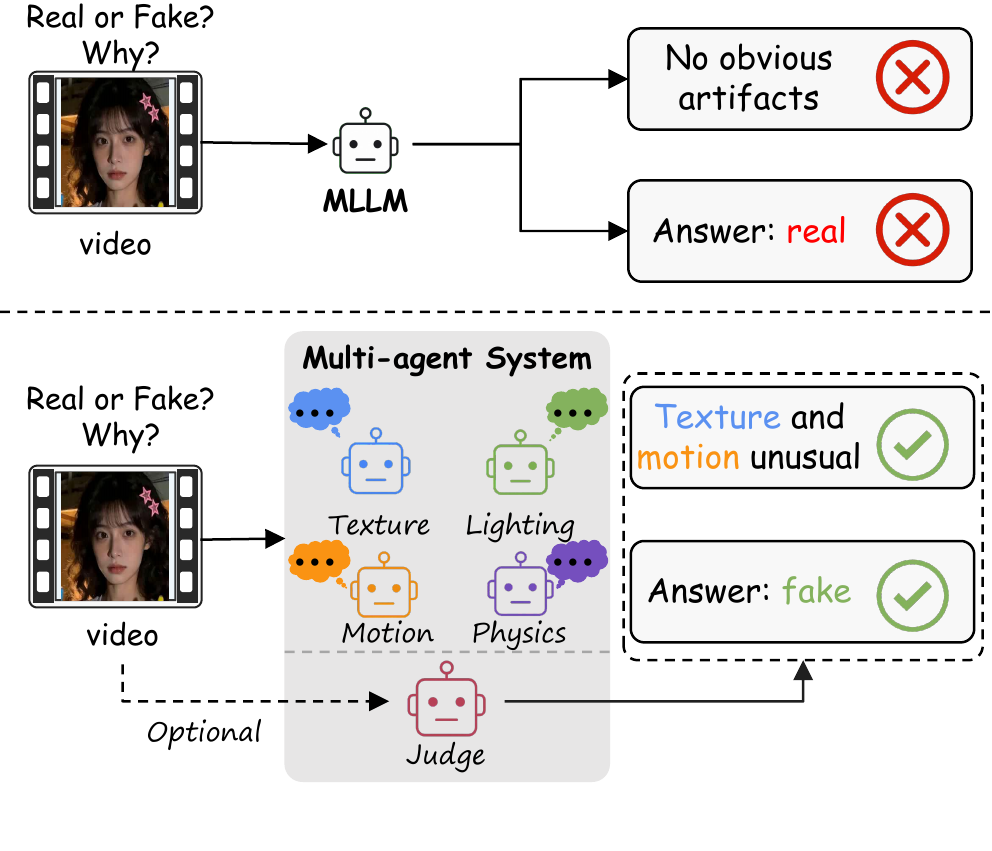
A single MLLM misses subtle artifacts while four specialist agents and a judge reach the correct decision
Figure 1: Framework comparison. A single MLLM often overlooks subtle forensic artifacts, which can lead to incorrect predictions. In contrast, our multi-agent framework employs specialized agents to examine the input video from four distinct forensic perspectives: texture, lighting, motion, and physics. A judge agent then aggregates their findings to produce a more reliable explanation and final prediction of whether the video under analysis is ultimately real or fake.

Abstract

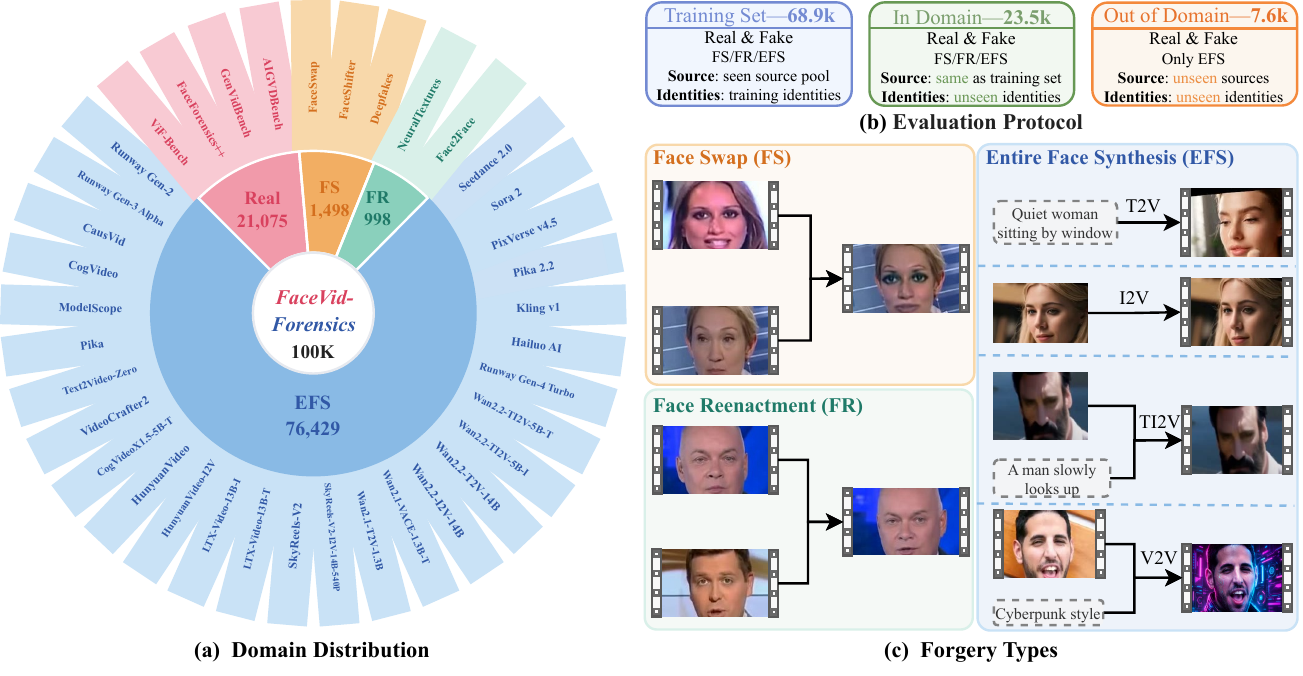
The malicious use of generative artificial intelligence to create highly realistic deepfake videos raises serious ethical concerns and poses substantial challenges to AI safety. However, existing deepfake video benchmarks provide limited coverage of recent synthesis methods and generally lack reliable fine-grained textual annotations. Meanwhile, conventional detectors and multimodal large language models (MLLMs), whether operating as a single model or relying on a single analytical perspective, often fail to capture subtle forgery artifacts, limiting their generalization to emerging AI-generated methods. To address these limitations, we introduce FaceVid-Forensics-100K, a large-scale deepfake video dataset comprising 100,000 videos and spanning 33 synthesis methods across face swapping, face reenactment, and entire-face synthesis, including recent generators such as Seedance 2.0. The dataset provides fine-grained textual annotations of visual observations and verdict-consistent forensic explanations, automatically synthesized through a multi-model aggregation and conflict-resolution pipeline powered by advanced MLLMs. Building on this benchmark, we propose a multi-agent forensic reasoning framework that employs four specialized domain-expert agents to independently analyze forgery cues from four perspectives: texture, lighting, motion, and physics. A judge agent then reconciles their reports to produce a final prediction together with an explanation. Extensive evaluations on out-of-domain test sets show that, despite being composed entirely of small open-source MLLMs, our framework outperforms all methods including closed-source GPT and Gemini models and ranks first across all reported metrics on this benchmark.
Overview

100K

Large-scale benchmark

21,075 real and 78,925 fake videos, with training, in-domain, and out-of-domain protocols.

33

Synthesis methods

Broad coverage of face swapping, reenactment, and recent entire-face generators such as Seedance 2.0.

4 + 1

Specialized reasoning

Four independent observers collect evidence; a separate judge resolves agreement and conflict.

Multi-Agent Forensic Reasoning

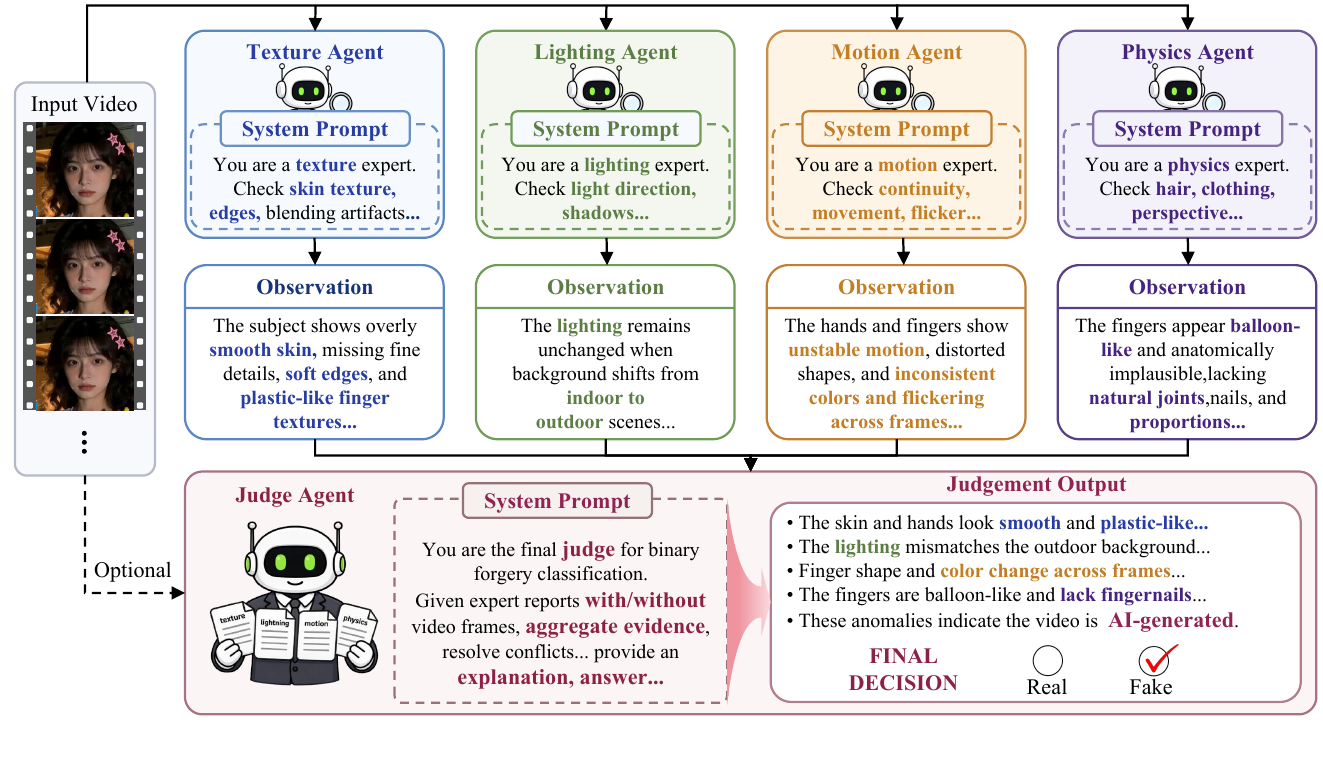
ARGUS separates evidence collection from decision making. Each observer is optimized for one forensic dimension and does not issue a final verdict.

ARGUS pipeline with texture, lighting, motion, physics, and judge agents
Method pipeline. Four independent observation agents produce inspectable reports. The judge combines those reports, optionally with sampled video frames, into an explanation and final decision.

1. Observe independently

Specialization encourages systematic cue discovery and prevents one early interpretation from anchoring every perspective.

2. Reconcile evidence

The judge weighs corroborating and conflicting reports rather than treating a single salient artifact as decisive.

3. Explain the verdict

The output pairs a binary prediction with a concise forensic rationale grounded in the observations.

FaceVid-Forensics-100K

The benchmark targets generalization to emerging generators and provides more than binary supervision.

FaceVid-Forensics-100K domain distribution, evaluation protocol, and forgery types
Dataset overview. The benchmark spans 33 synthesis methods and explicitly separates seen sources from unseen identities and generators.

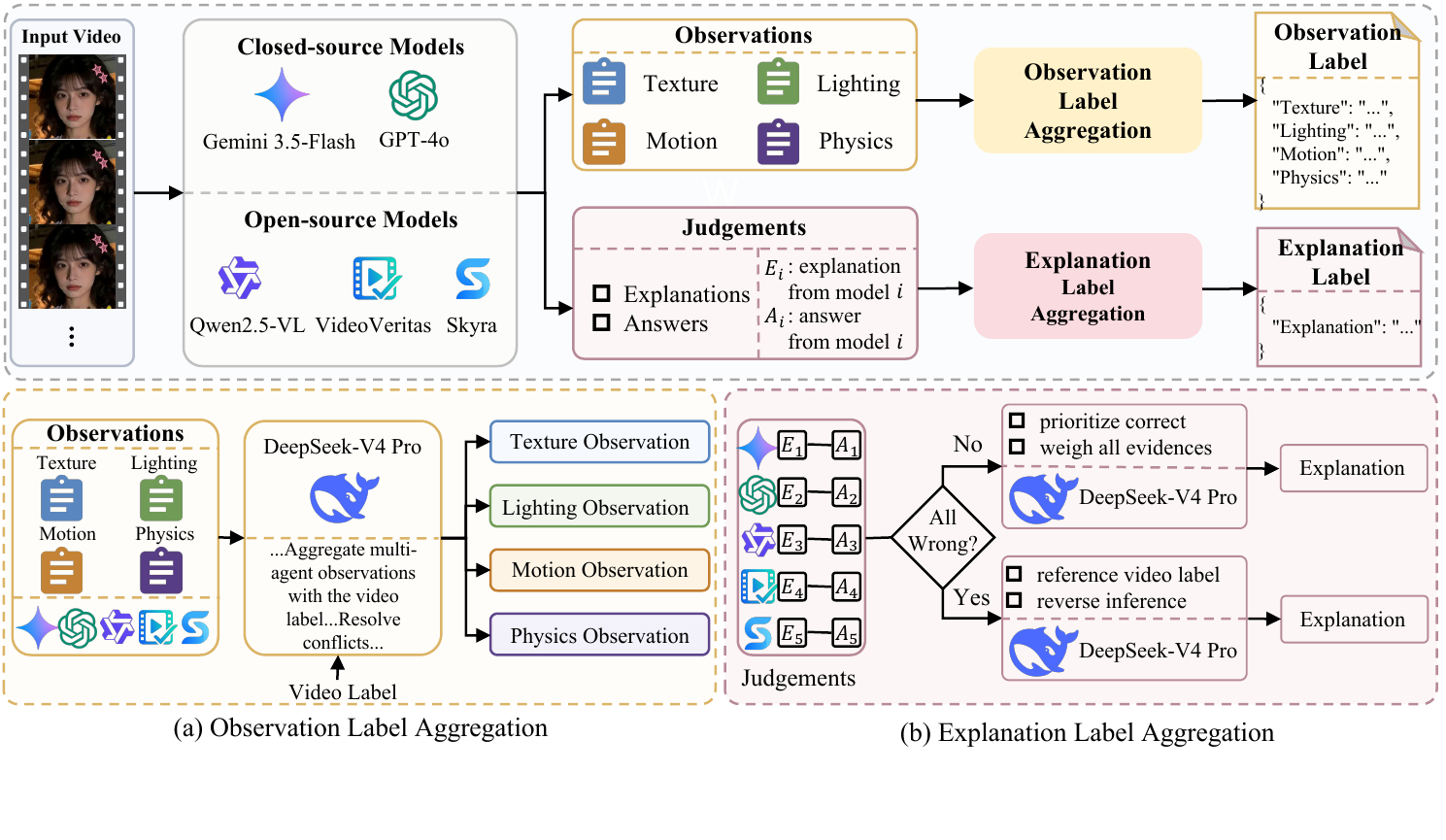
Annotation pipeline

Observation-label and explanation-label aggregation pipeline
Fine-grained labels. Multiple open- and closed-source MLLMs provide independent reports. Dedicated aggregation stages consolidate dimension-specific observations and produce verdict-consistent explanations.

Out-of-Domain Results

The full system ranks first across all reported metrics on the OOD test set.

Accuracy69.87
Recall81.82
F1 score53.28
MethodAccuracyRecallF1
Small vision models
DFGaze (TIFS’24)56.6717.9227.24
DFD-FCG (CVPR’25)61.2529.2239.16
Effort (ICML’25)63.9234.7944.76
TALL++ (IJCV’24)63.4742.9745.07
TFCU (CVPR’25)64.2833.4445.20
Open-source MLLMs
Qwen2.5-VL-7B35.9416.5113.24
InternVL3.5-8B37.8717.6014.53
MiMo-V2.5 (310B-A15B)49.8515.0018.69
Qwen3.6-35B-A3B53.1750.0535.72
Closed-source MLLMs
GPT-4o (2024)57.6340.3637.55
GPT-5-mini (2025)59.3138.7039.00
Gemini-2.5-Pro (2025)63.7875.2947.45
Gemini-3.5-Flash (2026)63.3458.7546.22
Forensics-tuned MLLMs
Skyra (CVPR’26)60.5030.0538.30
VideoVeritas (ICML’26)57.8778.9643.22
Multi-agent system
Ours (w/o Video)67.4165.0051.01
Ours (w/ Video)69.8781.8253.28

Values are percentages. Results are reported on 7,636 OOD videos from 20 generators excluded from training.

Qualitative Evidence

Hover over the filmstrip to inspect the sampled frames, then switch among the four independent Observation Agents. The Judge Agent reconciles their reports into the final ARGUS verdict.

Appendix Figure 1

Subtle evidence distributed across frames

Ground truth · Fake
Sampled frame 1 from Appendix Figure 1 Frame 01 / 09

Observation Agent

01 / 04

Texture Agent

Facial skin appears overly smooth and airbrushed. The hair looks waxy and lacks strand detail. Soft hairline boundaries and painterly foliage suggest synthetic texture.

Appendix Figure 3

Independence matters more than longer reasoning

Ground truth · Fake
Sampled frame 1 from Appendix Figure 3 Frame 01 / 09

Observation Agent

01 / 04

Texture Agent

The skin has an unnaturally smooth, waxy quality with a lack of fine pores and micro-textures. Severe blending artifacts, unnatural warping, and overly bright regions lack natural shading.

Prompt Templates

Browse the substantive Appendix F prompt instructions without expanding the page. Runtime data fields are omitted for clarity.


Cite

@misc{argus,
      title={Multi-Agent Forensic Reasoning for Generalizable Deepfake Video Detection}, 
      author={Xuechao Zou and Shun Zhang and Kai Li and Yi Zhou and Xinyu Sun and Yuhui Chen and Zhe Wu and Congyan Lang and Junliang Xing},
      year={2026},
      eprint={2608.06865},
      archivePrefix={arXiv},
      primaryClass={cs.CV},
      url={https://arxiv.org/abs/2608.06865}, 
}